Skip to content
A full moon low over open ocean at night

How it listens

One ayah at a time.

The unit of playback is a single ayah — not a surah, not a file. That is why the text on screen and the voice never drift apart, and why repeating, looping and pausing between ayat are possible at all.

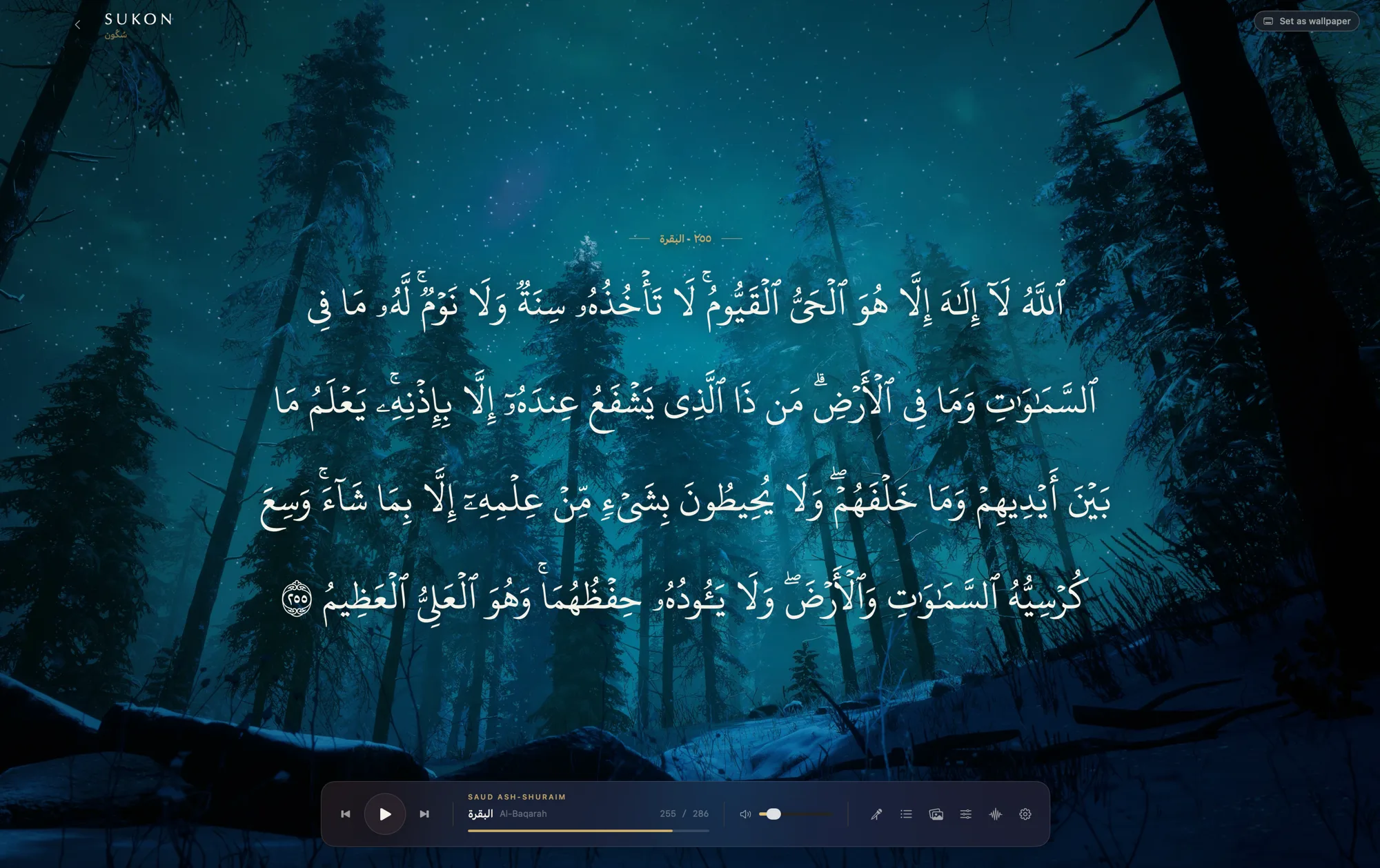
The Sukon window on a Mac: Āyat al-Kursī resting over a night scene of pines under an aurora, with the transport at the foot
Āyat al-Kursī, recited by Saud Ash-Shuraim, over Aurora Over the Pines. A screenshot of the real window.

The session panel · ⌘U

Four ways to listen

One app, four postures. Each changes what is on screen, how long the pauses are, and whether the words appear at all.

Recite

Continuous recitation with the ayah rising over the scene.

For working, walking, and the long stretches.

  • Arabic only
  • No pause between ayat
  • Any reciter

Reflect

Meaning alongside the words, with a breath between ayat.

For reading along and sitting with the meaning.

  • Arabic and translation
  • A breath between ayat
  • Timed reciters

Memorise

Loop a range, repeat each ayah, slow the pace.

For committing a passage to memory.

  • Repeat each ayah n times
  • Loop a range
  • Slow the pace

Stillness

Scene and ambience only. For rest and for sleep.

For rest, and for sleep.

  • No text at all
  • Scene and ambience
  • Fading sleep timer

Voices and meanings

Twelve reciters. Fifteen translations.

A reciter often has several recordings — Minshawi alone has Murattal, Mujawwad, the teaching muṣḥaf and the 1387 AH recording — and Sukon treats them as the different recitations they are, not as different files of the same thing.

114

Surahs

Every one, in full.

12

Reciters

Each with their own recordings.

15

Translations

Shown beside the words in Reflect.

Sound · ⌘K

Ambience with nothing to download.

Rain, wind, waves, a stream and a low drone, each on its own fader — every layer generated sample by sample as it plays. It never repeats, because there is nothing to repeat.

  • Rainy Night
  • Shore
  • Oasis
  • Desert Wind
  • Stillness

Details

Things you notice later.

Offline once heard

Every ayah you have listened to is kept on disk. A surah you have played once plays again with no connection at all — and the Arabic never needed the network to begin with, because the muṣḥaf text ships in the app.

A sleep timer that fades

It does not cut off. The recitation and the ambience come down together over the last stretch, so the room empties rather than snapping shut.

Menu bar and media keys

Play, pause and skip from the menu bar, the media keys, or Now Playing — without bringing the window forward.

The muṣḥaf’s own hand

The ayah is set in KFGQPC HAFS Uthmanic Script, the type the muṣḥaf is actually printed in. It is registered privately at launch, so it never touches your font book.

Keyboard

Hands stay put.

Space
Play / pause
← →
Previous / next ayah
⇧⌘[ ⇧⌘]
Previous / next surah
⌘L
Surahs
⌘J
Scenes
⌘K
Sound
⌘U
Session
⌘D
Live desktop wallpaper
⇧⌘E
Enter the scene
⇧⌘H
Back to the library

And beyond the Qur’an

Three realms, one room.

Radio carries live stations that simply keep going; Azkaar holds the morning and evening sets, counted and unhurried. Each has its own settings, and both sit in the same still frame as the recitation.

Qur’an

Recitation, ayah by ayah, over a scene

The unit of playback is a single ayah, which is why the text on screen and the voice never drift apart, and why repeating, looping and pausing between ayat are possible at all. Twelve reciters, fifteen translations, all 114 surahs.

Radio

Live stations, playing continuously

For when you would rather not choose. Open a station and it keeps going — recitation without a queue to manage, running behind whatever else you are doing.

Azkaar

Morning and evening remembrance

The morning and evening sets, counted and unhurried, in the same still frame as everything else. Each one rests over the scene for as long as you need it.